Salman Spiritual
Towards the Inner Vision of the Truth

"A messenger reciting unto you the revelations of Allah made plain, that He may bring forth those who believe and do good works from darkness unto light." — Holy Qur'an 65:11
Worship of Those Who Are 'Free'
Bismillahir Rahmanir Rahim
In the name of Allah, the Most Beneficent, the Most Merciful.
Ya Ali Madad! This post has two parts:
1. Festival Card;
2. Angelic Salwat Dhikr.
Part 1: Knowledge Section
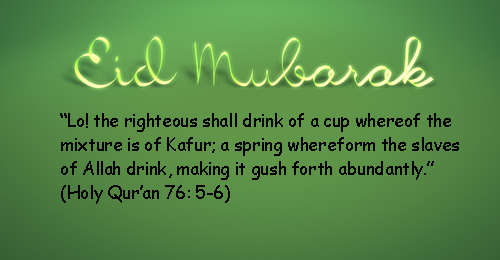
Idd Mubarak! On the most auspicious occasion of Idd ul-Fitr, please accept our heartfelt felicitations. May Allah grant material, spiritual and intellectual happiness to Muslims all over the world, and to all those who have submitted their wills to He Who is Above All Else. Ameen.
This post has five headings:
Introduction
Let us first read the following saying of Noor Mowlana Murtaza Ali (a.s.) in which he has defined three classes of people with respect to their obedience:
There are people who obey God to gain His Favours, they act like businessmen trading with God; while there are some who obey Him to keep themselves free from His Wrath (Anger), they act as slaves; but there are a few who obey Him out of their sense of gratitude and obligation, they act as gentlemen and noblemen."
Source: Nahjul Balagha: Sermons, letters and saying of Hazrat Ali, Sayings of Hazrat Ali 208, p. 294
In the old Idd Namaz, we used to recite Dua-e Qunut five times in the first raka'ah and four times in the second raka'ah. The first sentence is the following ayat of the Holy Quran (2:201):
Rabbanaa 'aatinaa fid-dunya hasanatanw-wa fil-'Aakhirati hasanatanw-wa qinaa 'azaaban-Naar"
Our Lord! Give unto us in the world that which is good and in the Hereafter that which is good, and guard us from the doom of FireSource: Holy Quran (2:201)
In the above ayat, we are asking for the best in this world and the first world (i.e. the world from which our soul originated), and we are seeking protection from the God's anger. Thus, we fit in to the first two classes of believers described by Noor Mowlana Murtaza Ali (a.s.). So we now we have seek answer to a more difficult question: How to worship God out of a sense of gratitude? Is it simply an issue of expressing gratitude through speech and thought or is there a deeper answer? In this post, let us explore the qualities and achievements of the few who worship through a real sense of gratitude.
Worship of Those Who Are 'Free'
I found another version of the above saying from the book titled 'Spiritual Quest—Reflections on Qur'anic Prayer According to the Teachings of Imam 'Ali' by Reza Shah-Kazemi, Occasional Papers 3, IIS, London (2011):
"...to the extent that one is aware that one has received the abundant good embodied in the Prophetic gifts—the Qur'an itself, the wisdom of Prophetic guidance—one can pray and sacrifice, as a manifestation of one's gratitude. One no longer prays only that one might be given some good in this world, or the next, but one prays out of gratitude for what has already been given, here and now. As noted earlier, Imam 'Ali refers to this kind of worship as being the worship of those who are 'free':
Indeed there is a group who worship God out of desire [for something not yet attained], and this is the worship of the merchants. And there is a group who worship out of fear, and this is the worship of the enslaved. And there is a group who worship God out of gratitude, and this is the worship of the free.
The Prophet, upon being asked why he persisted with such long prayer vigils through the night, replied by saying: 'Am I not a grateful servant?'"
Source: Reza Shah-Kazemi. 2011. Spiritual Quest. Occasional Papers 3, IIS, London, pp. 91-92
We have now moved forward with the above teaching and have discovered that the few who worship out of gratitude have the trait of being 'free'. Let us now look for some other sources of knowledge from the Holy Qur'an and the teachings of Noor Mowlana Murtaza Ali (a.s.) to find authoritative answers about those who worship out of gratitude.
What is the Difference Between Spiritual Slavehood and Ordinary Piety?
I found an answer to this question from another part of Reza Shah-Kazemi's book which is based on the ayats presented in the Idd card:
"The relationship between spiritual slavehood and ordinary piety is alluded to in the distinction between the 'slaves of God' ('ibad Allah) and the 'righteous' at verses 5-6. The Ahl al-Bayt are implied as the exemplars of the 'slaves of God', for it is their actions that are described in the verses that follow, culminationg in the feeding of others in preference to themselves. While 'the righteous' drink from a cup 'whereof the mixture is of Kafur', the slaves of God drink directly from the spring itself, 'making it gush forth abundantly' (76:5-6)."
Source: Reza Shah-Kazemi. 2011. Spiritual Quest. Occasional Papers 3, IIS, London , p. 47
What are the Traits of the Spiritual Slaves and the Righteous?
I found an answer to this question from another part of Reza Shah-Kazemi's book:
"The 'slaves' drinking directly from the fountain are empty of themselves, and 'belong' entirely to the Lord, in contrast to the 'righteous' who retain, alongside their piety, a lingering sense of self-consciousness, by which they are partly 'possessed' and thus cannot belong wholly to God as do the 'slaves'. They can only drink from a cup flavoured by the fountain, not from the fountain itself. Only those who are utterly empty of their egos, and who are thus filled by the presence of God, can drink directly from the fountain. But to be empty of one's ego is, from a relative point of view, a kind of death, from which the ordinary soul shrinks in fear: 'If ye claim that ye are friends of God (awliya' Allah), singled out apart from (all) mankind, then long for [a spiritual] death if ye are truthful' (62:6).
Esoterically interpreted, this challenge can be seen to underscore the relationship between spiritual extinction or fana and sanctity, or walaya. For it is the awliya, who truly 'long' for this extinction which means death to egocentricity, in accordance with the Prophetic injunction: 'Die before you die'. One must die to one's egotism before physical death comes, and only the awliya can do this, or even want to do this, knowing that in his apparent 'death' resides true life, for the effaced slave becomes transparent to the Lord, and the very duality of slave-Lord is transcended, leaving only divine oneness."
Source: Reza Shah-Kazemi. 2011. Spiritual Quest. Occasional Papers 3, IIS, London, pp. 47-48
What is the process of moving from Duality to Oneness?
Here is an explanation of the process of moving from the duality of the slave-Lord relation to transcending to divine oneness as described by Imam Ali (a.s.):
"This oneness is made apparent in the following remarkable saying by Imam 'Ali, which can be read as a commentary on the fountain of Kafur, and an intimation of what happens as a result of actually drinking from this fountain:
'Truly, God has a drink for His friends (awliya'ihi). When they drink it, they are intoxicated (sakaru);
and when they are intoxicated, they are enraptured (tarabu);
and when they are enraptured, they are blessed (tabu);
and when they are blessed they dissolve (dhabu);
and when they dissolve, they are free (khalasu);
and when they are free, they devote themselves purely (akhlasu);
and when they devote themselves purely, they seek (talabu);
and when they seek, they find (wajadu);
and when they find, they arrive (wasalu);
and when they arrive, they are at one (ittasalu);
there is no difference between them and their beloved.'"
Source: Reza Shah-Kazemi. 2011. Spiritual Quest. Occasional Papers 3, IIS, London, p. 48
Part 2. Angelic Salwat
Let us recite angelic salwats to invoke Divine grace and mercy.
Bismillahir Rahmanir Rahim
In the name of Allah, the Most Beneficent, the Most Merciful
Allâhumâ salli alâ Muhammadin wa âle Muhammad:
O Allah! Bestow Peace on and through Muhammad and his Descendants
or
Al-hamdu lillahi rabbil 'alamin.
Praise be to Allah, the Lord of the worlds!
Haizinda — Qayampaya
(Our Present Imam is Living and His NOOR is Eternal)
Idd-ul Fitr Cards